

Data governance · Data management · Analytics
Build data your organization can trust and act on.
Data governance and data management come first. We turn fragmented enterprise data into governed, AI-ready assets, with named owners, quality and security controls and modern pipelines, then build the models and dashboards leaders act on.
The challenge
Most data problems are ownership problems first.
Data is spread across operational systems, cloud applications, spreadsheets and records repositories. Systems disagree, definitions differ between teams, and customers find errors before your checks do.
Every new analytics, AI or personalization project inherits those inconsistencies, and better tools alone don't solve them. We fix the causes, from ownership and quality rules to pipelines and retention, then build the analytics and models on top.
Who this is for
Chief data officers and data leaders
A data strategy and governance program that people actually follow.
IT and enterprise architecture
A modern data platform and pipelines that replace fragile point-to-point connections.
Executives and business leaders
Forecasts and dashboards they trust enough to make decisions on.
Analytics, AI and marketing teams
Documented, approved data to build on, including consented customer data for Adobe.
Risk, privacy and compliance teams
Sensitive data classified and controlled, with evidence that the rules are applied.
Records and information managers
Retention and disposition that are consistent and defensible.
What we deliver
Services and capabilities
Our services are modular. We design, build and support the parts you need, from strategy, data management and governance to pipelines, models and dashboards. Cloud platforms and AI/ML enablement come from our Engineering & Technology practice.
Data strategy and analytics
Data investments drift when nobody has agreed what the data is for. We set a data and analytics strategy tied to business goals, and sequence the work that delivers it.
- Data and analytics maturity assessment
- Data strategy tied to business outcomes
- Analytics roadmap and prioritized use cases
- Success measures for each initiative
Data governance and data management
Data rules often live in documents nobody follows. We put owners, policies and shared definitions in place that stay in use, and manage data consistently across systems.
- Governance policies, standards and decision forums
- Named data owners and stewards, with training and support
- Business glossary, metadata and lineage
- Data management standards applied across systems
Regulatory compliance, data quality and security
The same errors get fixed by hand, and sensitive data is hard to protect when nobody knows where it is. We build quality rules into your data flows and classify and control sensitive information.
- Data profiling, quality rules and validation
- Quality monitoring and issue resolution
- Classification of sensitive information and role-based access
- Controls designed to support GDPR, CCPA and other obligations
Modern data architecture and engineering
Legacy warehouses and one-off extracts can't keep up with new sources and uses. We design and engineer data platforms that scale with your data and serve analytics and AI from one governed foundation.
- Target data architecture and platform design
- Data engineering: ingestion, transformation and modeling
- Scalable architecture that grows with data volumes
- Cloud data platforms on AWS and Azure, built with Engineering & Technology
Integrated data solutions
Systems disagree because each keeps its own copy. We unify multi-source enterprise data pipelines across databases, cloud services and on-premises systems, so data is accurate and accessible.
- Integration strategy and architecture
- Multi-source pipelines and consolidation across systems
- Real-time access where decisions depend on it
- Ongoing support and optimization
Data science and predictive modeling
Historical reports explain what happened but not what comes next. We build predictive models on governed data and turn their results into executive insights.
- Exploratory and statistical analysis
- Predictive modeling
- Executive insights tied to specific decisions
- Production models through AI/ML enablement in Engineering & Technology
Data storytelling and visualization
Dashboards nobody opens don't change decisions. We design visualizations and data stories around the questions leaders ask, built on shared definitions so the numbers agree.
- Dashboards and executive reporting
- Data storytelling for leadership and board audiences
- Shared metric definitions across reports
- Analytics built on governed, documented data
AI-ready data
Profiles, reports and AI tools inherit every error and consent gap in their data. We prepare customer and operational data, and the rules for using it, before the platforms and projects that depend on it go live.
- Documented, approved datasets for AI and analytics
- Data requirements and approvals for AI use cases
- Quality, identity and consent rules for customer profiles used in MarTech
- AI governance for the systems that use the data
Lifecycle, retention and records
Information kept forever adds cost and risk, and retention schedules on paper don't change daily work. We put lifecycle rules into use, so information is kept while needed and disposed of on a documented decision.
- Retention schedules, record series and file plans
- Defensible disposition, with decisions documented
- Records management in MapleRecord, our records platform
- AI-driven record management with MOLI
- Wider records and information governance through our Information Governance & Records practice
Our product · Information Governance & Records
Public sector and enterprise records management.
MapleRecord, designed and built by Maverick InnoGarage, is customized records management software for government, municipalities and regulated organizations, with workflow automation, a seamless user experience and lifecycle governance. Five integrated modules cover electronic and physical records, information requests, workflows, forms and administration. With MOLI, it is one of our two Information Governance & Records products. It puts the retention schedules and access rules described above into daily use.
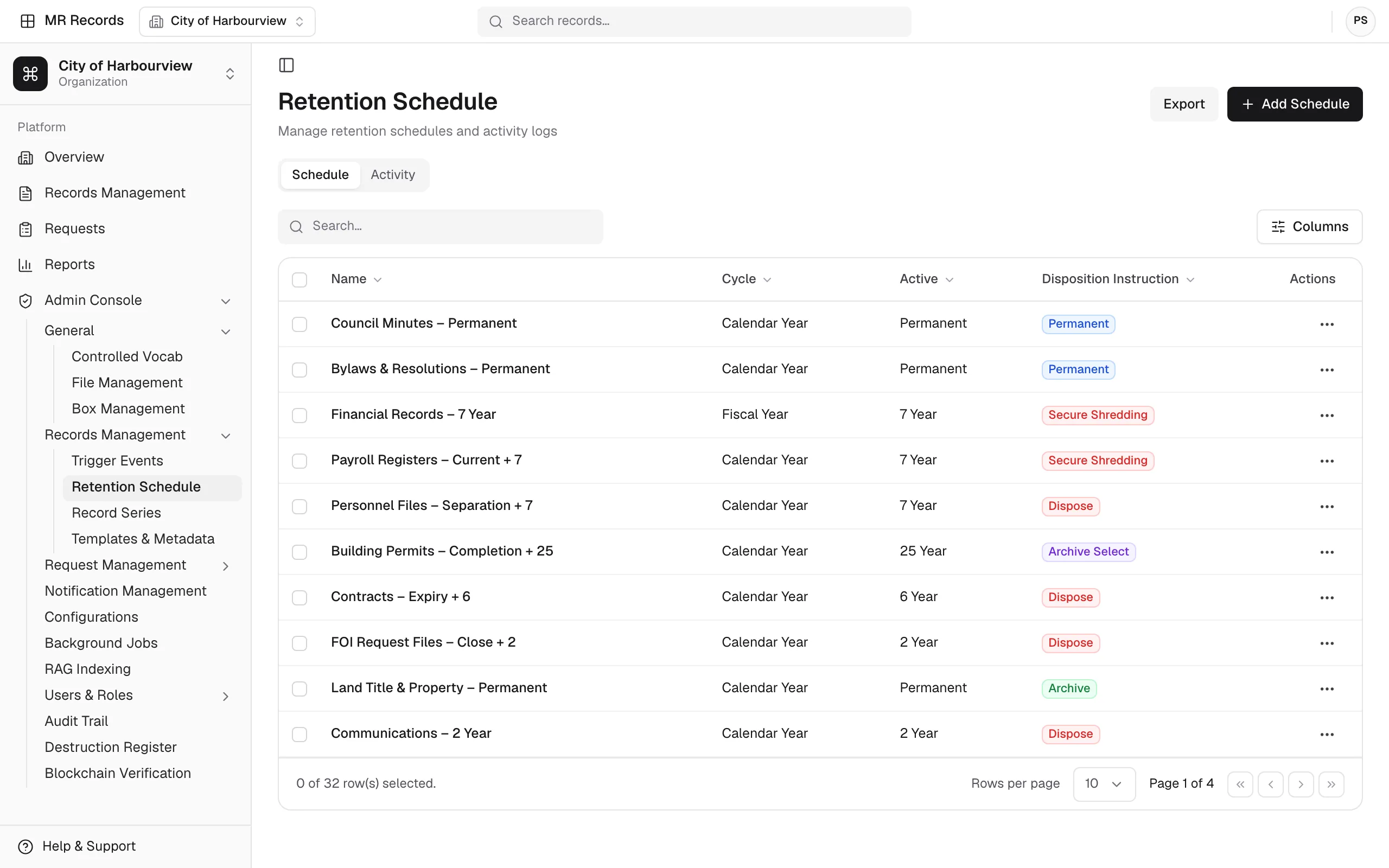
Product screens show sample data.
From vision to victory
Three stages, one accountable team
Each stage ends with something tangible you can review, use and build on. What you keep is listed under What you receive, further down this page.
- 01
Understand & strategize
Map critical data, systems, owners and pain points, profile quality where it matters most, and agree the decisions and use cases the data must serve.
- 02
Implement & integrate
Put governance roles and policies in place, build the architecture, pipelines and quality checks, and deliver the first models and dashboards with minimal disruption.
- 03
Optimize & grow
Monitor quality, adoption and model performance, extend governance to new data domains, and refine analytics as needs change.
Deliverables
What you receive
Practical outputs your teams can use, run and maintain.
Data strategy and maturity assessment
Where your data stands today, the outcomes it must support, and the priorities we implement first.
Governance framework and ownership matrix
Policies, standards, decision forums, and named owners and stewards for critical data domains.
Data architecture and pipelines
How systems connect, which source is authoritative, and working pipelines that move data reliably.
Quality rules and monitoring
Checks, thresholds and routines that catch issues before they reach reports, customers or AI systems.
Models, dashboards and executive insights
Predictive models and visualizations built on governed data, with the definitions behind every number.
Retention schedule and file plan
Record series, retention periods and disposition steps, which we can configure in MapleRecord.
Practical applications
How this work applies in practice
These are illustrative scenarios that show typical situations and approaches. They are not descriptions of specific client projects.
FAQ
Frequently asked questions
What does your Data & Analytics practice cover?
Data strategy and analytics, data governance and management, regulatory compliance, data quality and security, modern data architecture and engineering, integrated data solutions, data science, and data storytelling and visualization. Together they turn fragmented enterprise data into governed, AI-ready assets.
What is data governance?
Data governance is how an organization manages the availability, usability, integrity and security of its data. It covers who is accountable for data, the policies and standards that apply, and the processes that keep data accurate and compliant.
Where do you start?
You can start with the data that matters most to one outcome, such as a customer view, an executive dashboard, a regulatory report or an AI use case. We assess how that data is managed today, implement the priorities with you, then extend from there instead of trying to cover everything at once.
Do you build the pipelines and models, or only design them?
Both. We design the architecture, build and consolidate pipelines across databases, cloud and on-premises systems, develop models and dashboards, and provide ongoing support and optimization once they are running.
How does this relate to cloud engineering and AI/ML enablement?
Our Engineering & Technology practice builds and runs the cloud platforms on AWS and Azure and takes models into production through AI/ML enablement. Data & Analytics makes sure the data those platforms and models use is governed, high quality and approved for use. Most programs draw on both.
How does data management support Adobe and AI projects?
Adobe Experience Platform builds customer profiles from the data you send it, so duplicates, errors and missing consent can flow straight into audiences and personalization. We set quality, identity and consent rules before data is activated and apply them in Adobe Experience Platform as part of our MarTech work. AI governance depends on the same groundwork: knowing what data a system uses, who owns it and whether it may be used.
How do MapleRecord and MOLI fit with your records work?
MapleRecord, our records management platform for electronic and physical records, and MOLI, our AI-driven record management system, are designed and built by Maverick InnoGarage and are the products behind our Information Governance & Records practice. When a records program needs software, we configure retention schedules, record series and access in them. Schedules and file plans we develop with you don't depend on any particular system.
Connected expertise
Explore related services
- Information Governance & RecordsRecords lifecycle, retention and privacy compliance support, with MapleRecord and MOLI
- AI GovernanceResponsible AI, AI risk management and compliance support
- MarTech & Adobe Experience CloudCustomer data, content, personalization, analytics, marketing automation and commerce on Adobe
- Engineering & TechnologyCloud on AWS and Azure, DevOps, AI/ML enablement, mobile, QA and custom software
- Experience DesignUser research, service design, design thinking, content and CX optimization
- Digital & ProductDigital strategy, product vision, product development, go-to-market and agile delivery
- Business Transformation & CRMProcess optimization, change enablement, program management and Microsoft Dynamics 365
- All servicesCore expertise and all seven practice pillars, in one place.
Start a conversation
Fix the data your next project depends on.
Tell us about the systems, data and decisions that matter most. We'll scope a practical first step with you.